Culture & Heritage
The National Liberation Council Years (1966–1969) – A Solitary Northern Voice in Military Rule
The story of NLC Northern Ghana is the story of one man: Deputy Commissioner Bawa Andani Yakubu, the only northerner on the eight-member council that governed Ghana for three and a half years. His story, long overshadowed by more prominent figures, deserves to be told.

Welcome to our Northern Ghana’s Political Architects Series, exclusive to www.thesavannaonline.com. In Part One of our series, we explored the pioneering generation of northern politicians who organized under the Northern People’s Party in 1954 to fight for regional representation in the pre-independence Legislative Assembly. We met the founders—Tolon Naa Yakubu Tali, Simon Diedong Dombo, Mumuni Bawumia, J. A. Braimah, Abayifa Karbo, C.K. Tedam, Jatoe Kaleo, and Kpembewura Imoro Salifu—who laid the foundation for northern political engagement.
In Part Two, we followed these pioneers into the First Republic (1960–1966), where northerners like Ebenezer Adam, Emmanuel Adama Mahama, Tolon Naa Yakubu Tali, and Akantigsi Afoko served as MPs, regional ministers, and diplomats under President Kwame Nkrumah.
Now, in Part Three, we turn to a dramatic moment in Ghana’s political journey—the February 24, 1966, coup d’état that overthrew Nkrumah and ushered in three years of military rule under the National Liberation Council (NLC). In this era of generals and police commissioners, northern representation was reduced to a solitary voice. The story of NLC Northern Ghana is the story of one man: Deputy Commissioner Bawa Andani Yakubu, the only northerner on the eight-member council that governed Ghana for three and a half years. His story, long overshadowed by more prominent figures, deserves to be told.
The Coup That Changed Everything
In the early hours of February 24, 1966, while President Kwame Nkrumah was on a peace mission to Hanoi, a group of officers and men of the Ghana Army, led by Lieutenant Colonel Emmanuel Kwasi Kotoka and Major Akwasi Amankwa Afrifa, executed a meticulously planned operation code-named “Operation Cold Chop“. With police support, they seized control of strategic installations in Accra. By 1 p.m. that afternoon, a Radio Ghana spokesman announced to a stunned nation that the Convention People’s Party government had been overthrown.
The justification for the coup was stark. Nkrumah, the announcer declared, had “been running the country as his own personal property,” resulting in “gross economic mismanagement” from which “all of us have suffered”. Inflation and unemployment had taken hold. The nation was, in their words, “on the verge of national bankruptcy”.
The 1964 Constitution was abolished. Parliament was dissolved. The Convention People’s Party and all its auxiliary structures were banned. The new junta, as Kotoka declared, would “govern by decrees which shall have the force of law until a new constitution is promulgated”.
The National Liberation Council: Structure and Composition
The National Liberation Council that assumed power was unique among African military juntas of the era. Rather than being dominated exclusively by army officers, it was carefully balanced between four military leaders and four senior police officials—a reflection of the joint nature of the operation that had brought it to power.
The military wing was led by Lieutenant General Joseph Arthur Ankrah, a Ga who had once served as the first Ghanaian commander of the army. He became chairman of the council and would serve until April 1969. Alongside Ankrah stood Major Akwasi Amankwaa Afrifa, an Ashanti who played a crucial military role in the coup and would eventually succeed Ankrah as chairman. Colonel Emmanuel Kotoka, an Ewe and the operational mastermind, served until his death during a counter-coup attempt in April 1967. Colonel Albert Kwesi Ocran, a Fanti, completed the military quartet.
The police wing was equally distinguished. Commissioner John Willie Kofi Harlley, an Ewe who served as police commissioner, became deputy chairman of the council. Anthony K. Deku, also an Ewe, headed the Criminal Investigation Department. Commissioner J.E.O. Nunoo completed the police contingent.
And then there was Deputy Commissioner Bawa Andani Yakubu—the sole representative of NLC Northern Ghana on the eight-member council.
Bawa Andani Yakubu: The Face of NLC Northern Ghana
The German Wikipedia entry on the National Liberation Council, drawing on historical records, identifies Yakubu explicitly as “aus dem Norden des Landes”—from the north of the country. This simple designation carries profound significance. In an eight-member council that drew representatives from the Ga, Ashanti, Ewe, and Fanti ethnic groups, Yakubu alone represented NLC Northern Ghana at the highest level of the military government.
Who was this man who bore such weight on his shoulders? Bawa Andani Yakubu was born around 1924 in Gushiegu, now in the Northern Region of Ghana. He rose through the ranks of the Ghana Police Force to become a Deputy Commissioner. This senior leadership role placed him among the highest-ranking police officials in the country at the time of the 1966 coup. His professional competence and the trust he commanded among his fellow officers explained his inclusion in the eight-member council.
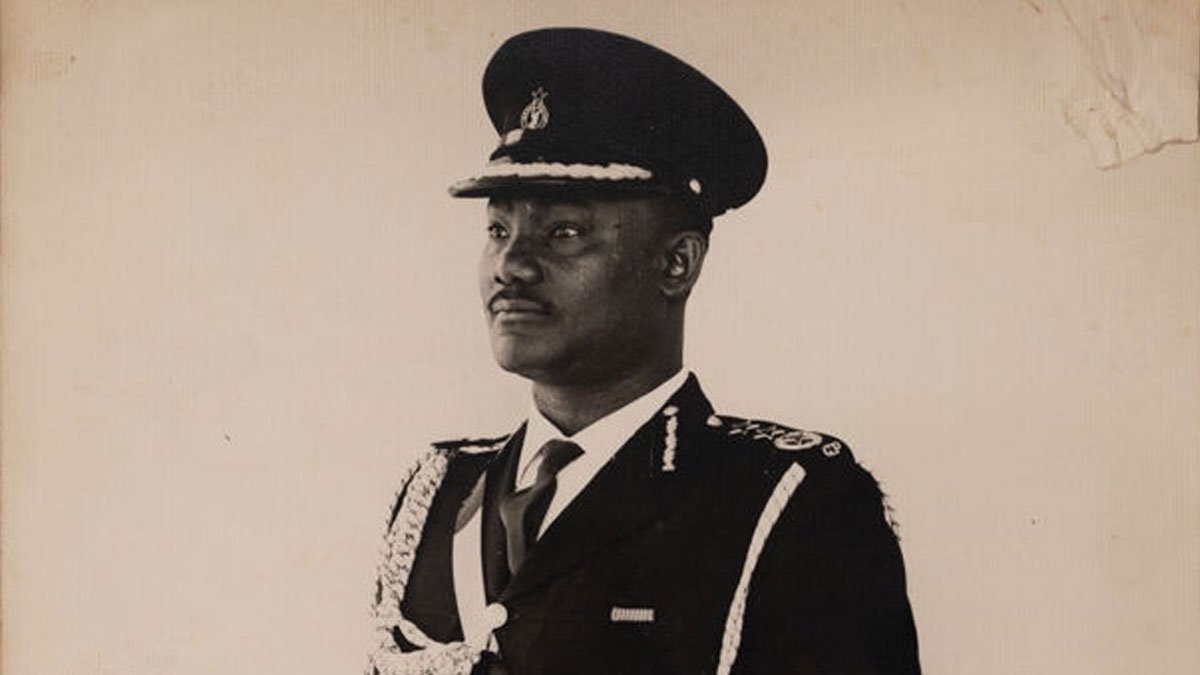
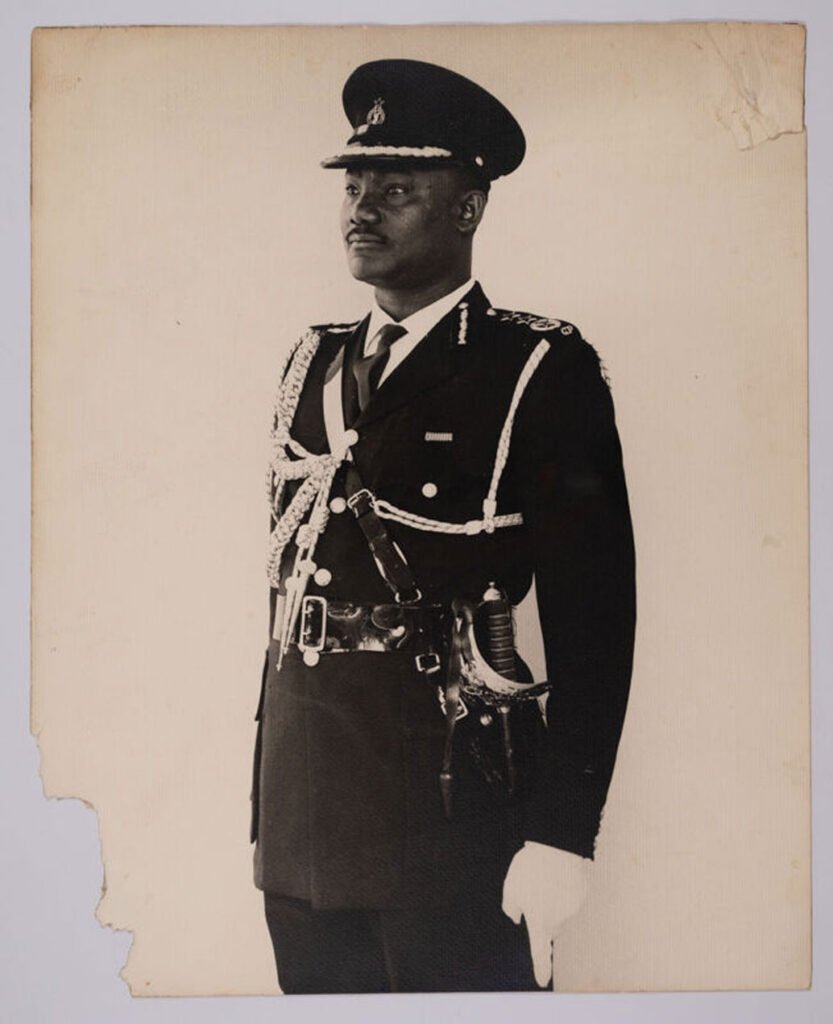
A remarkable photograph of Yakubu from this period has been preserved in the Willis E. Bell Photographic Print Archive at the Mmofra Foundation in Accra, now digitized through UCLA’s Modern Endangered Archives Program. The image shows a posed portrait of Deputy Commissioner Yakubu in his police uniform. This dignified, composed figure carried himself with the bearing of a senior law enforcement officer. The photograph, taken sometime between 1966 and 1969, captures him at the height of his political influence, serving as the embodiment of NLC Northern Ghana.
Yakubu’s service on the NLC extended from February 24, 1966, to August 29, 1969—the entire duration of the council’s existence. During these years, he participated in the deliberations that shaped Ghana’s recovery from economic crisis, its reorientation toward Western alliances, and its gradual transition back to civilian rule. In recognition of his service, he was honored with the Member of the Order of the Volta in 1969.
When the NLC was dissolved and Ghana returned to civilian rule under the Second Republic, Yakubu’s career took a new direction. On September 27, 1969, he was appointed Commissioner of Police (Administration) and later rose to the rank of Inspector General of Police, serving in that capacity until June 12, 1971.
But perhaps the most significant chapter of his life began even before he left the police force. In February 1971, at the age of 48, Yakubu was enskinned as Gushie-Naa, the paramount chief of Gushiegu in the Northern Region. The enskinment was performed by the Ya-Na Abdulai Mahama IV, and he succeeded his late brother, Gushie-Naa Sugri Issah, who had died in 1969. This transition from police commissioner to traditional ruler exemplified the seamless connection between modern public service and traditional authority that has characterized northern leadership throughout Ghana’s history.
Yakubu resigned from the police force to take up his new role as Gushie-Naa, bringing his career in law enforcement and national politics to a close. He would serve as a traditional ruler for three decades. On January 6, 2002, Gushie-Na Bawa Andani Yakubu passed away at the age of 78. A government delegation led by Alhaji Malik Al-Hassan Yakubu, the Northern Regional Minister, attended his burial ceremony in Gushiegu.
The Significance of NLC Northern Ghana Representation
The presence of NLC Northern Ghana representation on the military council was not merely symbolic. In practical terms, it ensured that when decisions were made about regional administration, economic policy, and political transition, northern interests had an advocate at the table.
During the NLC’s tenure, the council appointed a Commissioner for the Northern Region—a military or police officer who oversaw regional administration. While the records do not specify who held this position during the NLC years, the fact that a northerner sat on the council itself meant that regional concerns could be raised directly at the highest level of government.
The NLC also made appointments to various commissions and committees that shaped policy. Northerners who had not been closely associated with the Nkrumah regime began to emerge as potential leaders for the upcoming civilian government. Figures like Simon Diedong Dombo, J. A. Braimah, and others positioned themselves for the political restoration that would come with the Second Republic. The groundwork for northern participation in the Busia government was laid during the NLC years, and the presence of NLC Northern Ghana representation helped maintain the political space for that groundwork.
For ordinary northerners, knowing that a son of the north sat on the governing council provided reassurance that their region had not been forgotten. In an era when the military could have excluded northern voices entirely, Yakubu’s presence kept the door open for northern political engagement.
The NLC’s Policies and Their Impact on the North
The National Liberation Council inherited an economy in crisis, and its response shaped the lives of all Ghanaians, including those in the north. The new rulers moved quickly to stabilize the situation, implementing austerity measures that brought both pain and, eventually, recovery.
The Omaboe Economic Committee recommended honoring the country’s indebtedness, which stood at 889 million pounds at the time of the coup. This commitment to repaying debts signaled to creditor nations that Ghana was open for business. Western nations responded with food aid, medicines, and loans.
Domestically, the NLC took painful but necessary steps. Nkrumah’s ambitious Seven-Year Development Plan was reappraised, and projects considered “prestigious” rather than essential were scrapped. The number of ministries was reduced from thirty-two to seventeen. Administrative districts were reorganized, reduced from 167 to 47.
For the north, the NLC’s policies had mixed effects. The reduction in government spending led to delays or cancellations of development projects in the region. The focus on austerity limited investment in infrastructure. Yet the stabilization of the economy eventually benefited all Ghanaians, including northerners, as inflation eased and essential goods became more available.
The NLC also established commissions of inquiry to investigate corruption under the previous regime. For northerners who had served in the Nkrumah government, these commissions brought scrutiny. Ebenezer Adam, whom we met in Part Two, was investigated by the Jiagge Commission and emerged with his integrity intact, found to be a “clean man” who had not abused his office for personal gain. Others were less fortunate.
The Counter-Coup of 1967
The NLC’s grip on power was tested on April 17, 1967, when Lieutenant Samuel Arthur led a regiment from Ho in an attempt to overthrow the military government. At the Flagstaff House, the plotters encountered NLC member Colonel Kotoka. In the ensuing firefight, Kotoka and three other officers were killed. The counter-coup ultimately failed, and its surviving leaders were executed or imprisoned.
For NLC Northern Ghana representative Bawa Andani Yakubu, the counter-coup demonstrated the dangers that surrounded military rule. The violence underscored the council’s fragility and the constant threat of further instability. It also reinforced the importance of a steady hand in navigating the transition back to civilian government.
For the north, the counter-coup had little direct impact. Still, it underscored the instability that would plague Ghana for decades. The ease with which disaffected officers could attempt to seize power set patterns that would recur in 1972, 1978, 1979, and 1981. Military rule, far from bringing stability, had opened a Pandora’s box of political violence.
The Transition to Civilian Rule
Despite the challenges, the NLC remained committed to its promise of returning Ghana to civilian rule. The ban on political parties remained in force until late 1968. Still, activity by individual figures began much earlier with the appointment of a succession of committees composed of civil servants and politicians as the first step toward democratic restoration.
These moves culminated in the appointment of a representative assembly to draft a constitution for the Second Republic. Political party activity was allowed to commence with the opening of the assembly. By election time in August 1969, five parties had been organized.
The major contenders were the Progress Party, headed by Kofi A. Busia, and the National Alliance of Liberals, led by Komla A. Gbedemah. The Progress Party found much of its support among the old opponents of Nkrumah’s CPP—the educated middle class and traditionalists of the Ashanti Region and the North. This link was strengthened by the fact that Busia had headed the National Liberation Movement and its successor, the United Party, before fleeing the country to oppose Nkrumah from exile.
The elections, held on August 29, 1969, demonstrated interesting voting patterns. The Progress Party carried all the seats among the Asante and the Brong. All seats in the northern regions of the country were closely contested. Overall, the Progress Party gained 59 percent of the popular vote and 74 percent of the seats in the National Assembly.
The NLC kept its promise. In September 1969, it was replaced by a three-member Presidential Commission chaired by General Afrifa, which would oversee the final stages of the transition. On October 1, 1969, the Second Republic was inaugurated with Kofi Abrefa Busia as Prime Minister and a newly elected parliament taking its seats. With the dissolution of the NLC, the chapter of NLC Northern Ghana representation came to a close—but a new chapter of northern political achievement was about to begin.
Northern Political Figures During the Transition
While the NLC governed from Accra, northern political life continued in muted form. The ban on political parties meant that aspiring politicians could not organize openly. Still, they maintained networks and connections that would prove valuable when elections were finally called.
The disqualification of former CPP officials from standing for office for 10 years created space for a new generation of leaders to emerge. Figures who had not been closely associated with the Nkrumah regime now came to the fore. Simon Diedong Dombo, who had led the Northern People’s Party before its merger into the United Party and who had not served in the Nkrumah government, was positioned to play a leading role in the Second Republic. He would serve as Minister for Health and later Minister for the Interior in the Busia government.
J. A. Braimah, another founding member of the Northern People’s Party, would serve as Northern Regional Minister. John S. Nabila, then a young academic, would enter parliament as a member for Walewale. The political families that would dominate later decades—the Mahamas, the Bawumias, the Dombo family—continued to maintain their influence in their communities, waiting for the spring of civilian government to bring their aspirations to bloom.
The presence of NLC Northern Ghana representation during the transition years helped maintain the political space for these figures to emerge. Yakubu’s service on the council demonstrated that northerners could participate in national governance even under military rule, and his example inspired others to prepare for the restoration of civilian government.
The Legacy of NLC Northern Ghana Representation
The years of the National Liberation Council left a complex legacy for Northern Ghana. On the one hand, the region was represented at the highest level of military government through Deputy Commissioner Yakubu, ensuring that NLC Northern Ghana was not just a phrase but a reality of political inclusion. On the other hand, the banning of political parties and the disqualification of former CPP officials disrupted the political careers of northerners who had spent years building experience and connections in national politics.
The NLC’s economic policies, while necessary to stabilize the economy, fell heavily on ordinary Ghanaians, including those in the north. The closure of state enterprises and layoffs reduced economic opportunities in a region that already lagged behind the South in development. The focus on austerity over investment meant that infrastructure projects in the north received limited attention.
Yet the NLC also created the conditions for the Second Republic, which would see northerners achieve significant political representation. Simon Diedong Dombo’s service as a cabinet minister, the election of numerous northern MPs, and the continued engagement of northern political families in national affairs all trace their roots to this transitional period. The foundation laid by NLC Northern Ghana representation helped ensure that when civilian government returned, northern voices would be ready to resume their place in the nation’s political life.
For Bawa Andani Yakubu himself, the NLC years were but one chapter in a remarkable life of service. From police officer to military council member to Inspector General of Police to Gushie-Naa, he exemplified the multiple roles that northern leaders could play in the life of the nation. His presence on the National Liberation Council ensured that the solitary voice of NLC Northern Ghana was heard when decisions were made that would shape Ghana’s future. It is a legacy worth remembering.
A Solitary Voice, A Lasting Presence
The story of the National Liberation Council years is often told through the eyes of its more prominent members—Ankrah, Afrifa, Kotoka, and Harlley. But the full picture requires us to also see through the eyes of Bawa Andani Yakubu, the man from Gushiegu who embodied NLC Northern Ghana during three and a half years of military rule.
His presence on the council reminds us that northern representation in national governance persisted even in the most challenging circumstances. When parliaments were dissolved, parties were banned, civilian politicians were silenced, and military officers ruled by decree, the north still had a voice at the table. That voice may have been solitary, but it was not silent.
As we move forward in this series to the Second Republic, we will see northern voices multiply and northern influence grow. Simon Diedong Dombo will serve in the cabinet. J. A. Braimah will administer the Northern Region. A new generation of MPs will take their seats. The foundations laid by the pioneers of Part One, consolidated by the First Republic MPs of Part Two, and maintained by the solitary voice of NLC Northern Ghana in Part Three, would support an expanding edifice of northern political achievement.
The story of northern Ghana’s political architects continues.
Key Figures of the NLC Era
Deputy Commissioner Bawa Andani Yakubu stands as the sole northern representative on the National Liberation Council, the living embodiment of NLC Northern Ghana. Born around 1924 in Gushiegu, he rose through the ranks of the police force to become Deputy Commissioner. He served on the NLC from February 24, 1966, to August 29, 1969, and was honored with the Member of the Order of the Volta in 1969. He later served as Inspector General of Police from September 27, 1969, to June 12, 1971, before being enskinned as Gushie-Naa, paramount chief of Gushiegu, in February 1971—a position he held until his death on January 6, 2002.